
Dear friends, colleagues, and mentors,
Before the summer begins - and before the wave of IPOs that will, as always, send some noise through our markets, I want to set the current world aside and write about something further out: what real estate intelligence could become?
So treat this as a thought experiment. A clear-eyed piece of imagination about where machine understanding of real estate might ultimately go, written in the spirit of a research note rather than a product update.
Here is the question underneath it.
Usually, software treats a building as a fixed thing. A record. A rent roll. A valuation. A row in a spreadsheet. But no asset is fixed. A warehouse is shaped by its power capacity, its access to transport, the potential automation inside it, the zoning around it, and the tax and regulatory regime above it. An office is shaped by tenant demand, financing conditions, and the slow rewriting of how cities use space. Change any one of those, and the asset changes with it.
So what would it take for a machine to understand real estate not as a snapshot, but as a system that moves?
What today’s tools miss
The first wave of real estate technology did something valuable. It digitized information. Records were aggregated. Spaces were mapped. Valuation models got better.
But digitizing data is not the same as understanding it.
A machine can read a sale price without understanding the negotiation, the timing, or the capital-market backdrop behind it. It can store a lease without understanding the judgment inside it. Real estate data is everywhere, but it lives in fragments: title and ownership records, leases, operating statements, appraisals, permits, zoning codes, environmental reports, and the local knowledge that never gets written down.
Reml’s first job is to make that scattered world legible: to structure it, connect it, and reason over it. That is the work we are doing today, and it is why our current AI foundation is language-model-first. Large language models are the right tool for this stage: they are strong at reading messy documents, extracting what matters, and explaining it back clearly. When grounded in source documents and structured data, they give us a practical base to build on now: a way to make real estate information readable, searchable, and explainable.
But it raises a bigger question, and this is the imaginative leap. Once a machine can finally read all of this, what could it eventually learn to do with it?
A different kind of model
This is where an idea from a very different field becomes useful.
In robotics, researchers talk about a “world model.” The plain-English version: instead of only reacting to what it sees, a robot builds an internal model of how its environment will change if it acts - what happens if it pushes, lifts, or drops something. It can reason about the consequences before it moves.
The more technical version is useful too. In recent robotics research, world models are described as predictive representations of how environments evolve under actions. Their value is not simply that they can imagine futures, but that they can support planning, simulation, evaluation, and learning before the system acts.
The analogy to real estate is striking.
A robot needs to understand what happens if it grasps an object. A real estate system would need to understand what happens if a building is repositioned, refinanced, rezoned, retrofitted for automation, or exposed to a shift in regulation.
A robot needs a model of the physical world. Reml, one day, would need a model of the real estate world.
Not a database of what an asset is. A model of how an asset changes - and how that change depends on the actions, constraints, shocks, and decisions around it.
One thing worth being clear about: this would not look like a machine generating video of a city evolving over ten years. Real estate does not need that. It needs a system that can model the states that matter - physical, financial, legal, regulatory, environmental, and market - and how a specific change moves them.
The grounded version is not photorealistic simulation, but state-transition modeling: understanding how the variables that matter in real estate move together when something changes.
The bridge: the digital twin
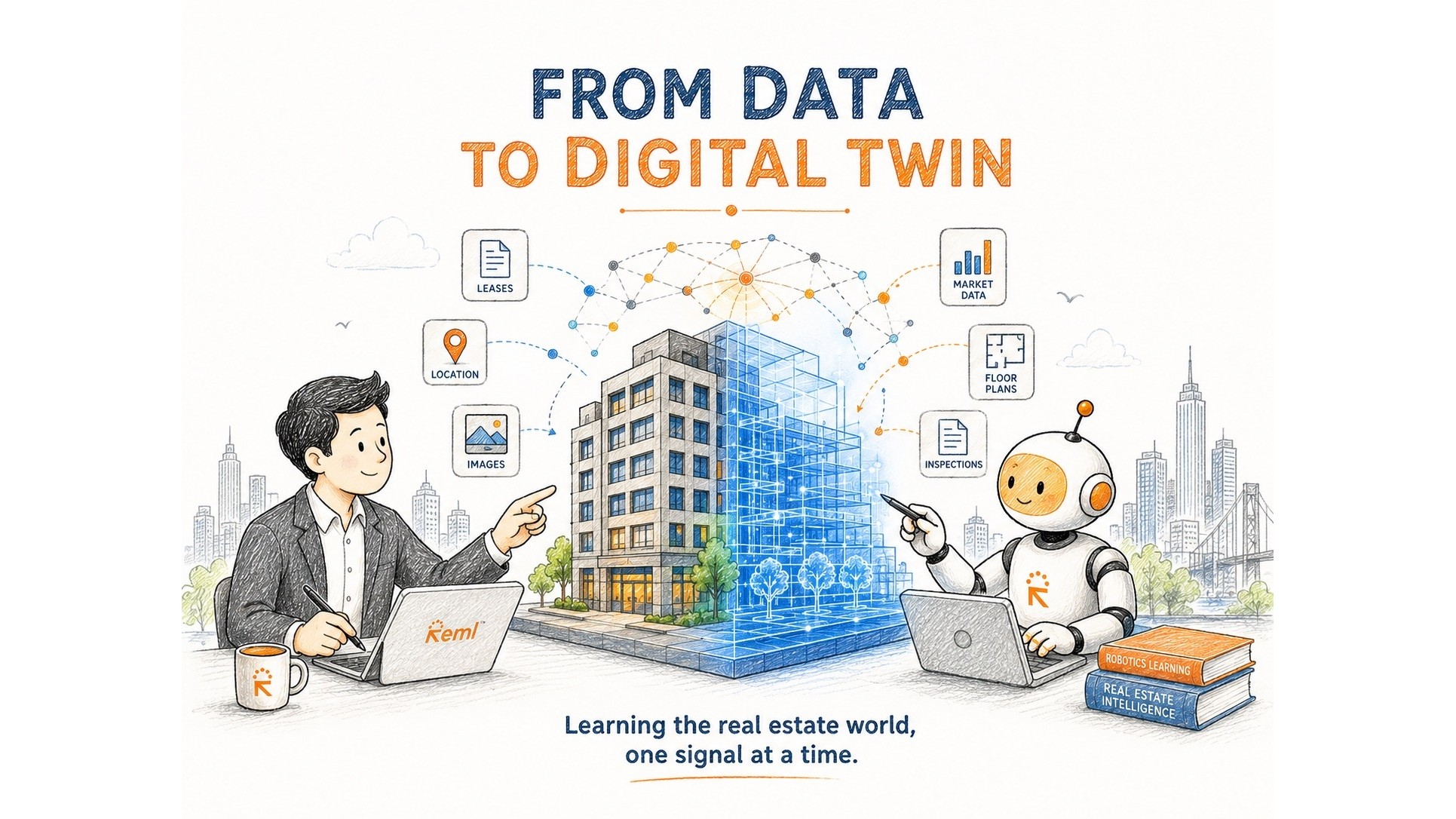
The bridge between today’s tools and this longer-term vision is what is often called a digital twin: not merely a 3D replica of a building, but a living representation of an asset and everything around it.
A useful digital twin would know more than square footage and last sale price. It would track an asset’s physical state: condition, systems, power and infrastructure capacity, suitability for modern uses. It would track its legal and regulatory state: zoning, entitlements, permitted use, what can be built or converted. It would track its financial state: value, income, financing exposure, tax exposure. And it would track its market and location context: demand, comparable assets, infrastructure, tenant behavior, and the broader direction of the submarket.
Most important, it would track time: what changed, when, why, and what might change next.
In this framing, the digital twin is the living state of the asset; the world model is the long-term ambition to understand how that state changes.
Today’s property databases tell you what has been recorded. A digital twin would help infer what is actually real.
Why this matters for Reml
The point of all this is not prediction for its own sake, but better decisions.
Imagine asking a future Reml: “What happens if this region’s power and grid capacity expand?”
A “world-model” approach would reason through the whole chain: which assets become viable for data-center or advanced-logistics use, how demand and rents shift, how land values change, how infrastructure constraints move from bottleneck to advantage, and how nearby assets may reprice as the market updates its view.
Or: “What if zoning is reformed to allow office-to-residential conversion, or to make an obsolete office asset viable for a new use?”
The system would reason through entitlement probability, conversion cost, physical feasibility, tenant or buyer demand, financing impact, tax treatment, and how comparable assets would reprice as the rules change.
Or: “What if a tax reform changes depreciation treatment?”
It would trace the effect through after-tax returns, investor appetite, holding-period decisions, and where capital is likely to rotate.
Or the most honest question of all: “What would change your mind?”
A system that understands its own uncertainty could tell you exactly which new fact - an updated entitlement, a signed lease, a regulatory ruling, a financing quote, a utility upgrade, a rent comp, a new sale - would most move its answer.
That is the difference between a tool that gives you a number and a system that helps you think.
Held with humility
This vision is ambitious, and it should be held carefully - which is exactly why it belongs in a letter like this rather than in today’s product.
Real estate data is noisy. Transactions are sparse. Markets shift. Local context matters. Human behavior resists prediction. Regulatory constraints vary asset by asset and jurisdiction by jurisdiction. Even the same physical building can mean different things depending on the capital stack, tenant demand, tax regime, infrastructure, and timing around it.
The robotics research that inspired this thinking is candid that world models still face hard technical problems: causal alignment, long-horizon reliability, evaluation, efficiency, and real-world grounding. Those problems are harder, not easier, in real estate.
A model may generate a plausible future and still be wrong about causality. It may identify a trend and miss the legal constraint. It may understand the financial math and miss the local nuance. It may be directionally right in one cycle and fragile in the next.
So we are not claiming Reml can build this tomorrow, and we are not building on it today.
Our foundation now is the language model, deliberately, because it is what gives clients real value in this market. It helps us read, structure, connect, and explain real estate information at a level that was not previously possible.
The world model is one of the directions we build toward, one proven layer at a time, starting from where we are strongest.
The future we imagine
The best institutional investors already think this way.
They do not just ask what an asset is worth. They ask what is really going on, and what might happen next. They carry a working model of the market, the regulatory landscape, the capital environment, and the future in their heads.
They understand that value is not a static number. It is a path through time.
A building can be cheap for a reason. Expensive for a reason. Mispriced because the market has not yet understood a constraint. Mispriced because the market has not yet understood an option. Mispriced because the relevant future has not yet become obvious.
The long-term ambition is to make that kind of judgment scalable.
Today, we build the data and language-model foundation.
Tomorrow, richer digital twins.
Over the long run, and this is the part worth imagining now, before the noise of the season sets in, a model that can reason about the built world the way the best investors already do.
Not static records. A living intelligence layer for real estate.
That is the future we imagine. And the work begins with the unglamorous but essential first step: making the real estate world legible to machines.
Curious to hear your view on this.