
Building in Silicon Valley can feel like living inside a bubble.
Over time, it’s easy to forget that the rest of the world moves at a different pace — that what feels obvious here can feel abstract, even distant elsewhere. And that the growing gap in understanding technology is not just real, but increasingly a barrier to adoption.
A few weeks ago, I was traveling outside the U.S. I sat down with a friend — an experienced real estate investor, thoughtful, curious, and open to learning. We spent about twenty minutes discussing what we’re building and how it might support the industry.
Then he paused and asked:
“What is a token?”
It was a simple question. And a genuine one.
It stayed with me — not just in that moment, but later that evening, and on the 11-hour flight back to Silicon Valley.
Because beneath that question is something deeper:
A widening gap between how technology is built, and how industries understand, adopt, and trust it.
A gap we need to close — if we want progress to be shared, not siloed.
So — what is a token?
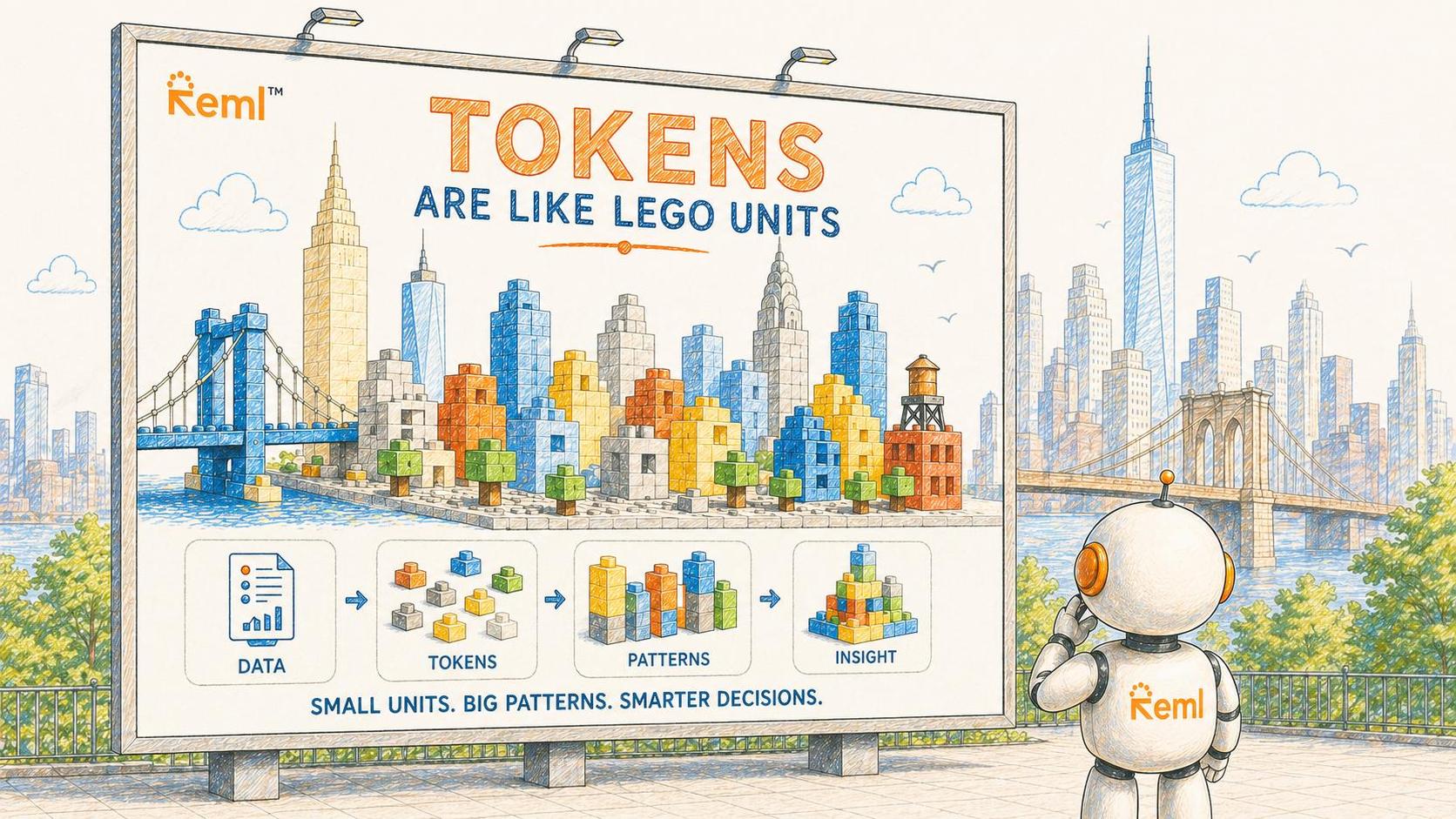
A token is the smallest unit of information an AI system can process — a word, or even part of a word, broken down so it can be converted into numbers and analyzed mathematically.
But that definition, while accurate, doesn’t really help.
A better way to think about it:
When you write a sentence, you see a complete idea.
The AI doesn’t. It breaks the sentence into small pieces — like Lego bricks — and learns patterns from how those pieces have been assembled before. Then it builds a response, piece by piece.
Tokens are those Lego bricks.
They sit underneath the system. quiet, mechanical, necessary — but not where the real value shows up.
From Buildings to Trees
We often think of real estate as something Static. Solid. Fixed.
But in reality, it behaves more like a living system — closer to a tree than a building. It grows, adapts, responds to its environment. Over time, it strengthens — or weakens — depending on the conditions around it.
And like any living system, everything begins with the soil.
In AI, data is the soil: transactions, comps, site visits, conversations, documents, market shifts — everything we’ve observed and recorded over time.
AI draws from this soil, breaks it into tokens — its nutrients — and learns patterns.
This is where it becomes powerful.
Because real estate is not a simple system:
● pricing depends on many interacting variables
● relationships are often non-linear
● markets shift — sometimes gradually, sometimes suddenly
Humans simplify.
Excel formalizes.
AI expands what can be seen.
How Different Systems Think
To make this more concrete:
| Human Judgment | Structured Modeling (Excel) | Machine Learning (AI) |
How it works | Experience + intuition | Pre-defined formulas | Learns patterns from data |
Data handled | Limited, selective | Structured, finite | Large, structured + unstructured |
Pattern detection | Strong but inconsistent | Only what is defined | Learns patterns automatically |
Complexity handling | Simplifies reality | Breaks in high dimensions | Handles many interacting variables |
Adaptability | High, but slow | Static unless updated | Continuously improves with data |
Output | Opinion | Single number | Range of likely outcomes |
Each system has strengths.
The opportunity lies in combining them well.
We’ve Been Here Before
AI feels new. But the trust problem is not.
When Excel was first introduced, very few people understood how it worked internally. Most investors today still don’t.
When you type:
= A1 + B1
What looks like a simple instruction is actually a translation across layers:
What you see:
= A1 + B1
↓
What Excel understands:
Take value in A1
Take value in B1
Add them together
↓
What the machine executes:
value_A = get_cell("A1")
value_B = get_cell("B1")
result = value_A + value_B
Behind the scenes, Excel is:
● parsing your formula
● mapping references to memory
● building dependency relationships
● recalculating only what changes
It is doing far more than what is visible on the surface.
But users don’t need to understand any of that.
Excel became trusted because:
● its structure is visible
● its logic is traceable
● its outputs are testable
● and its behavior is consistent
Understanding the underlying code was never the requirement.
Seeing how results are formed — and being able to work with them — was.
Think about a jet engine.
Most of us cannot explain how it works. It is far more complex than Excel — or AI. And yet we trust it — every time we board a flight.
Not because we understand the engine,
but because we trust the system around it.
Complexity does not eliminate trust.
Poor design does.
AI Is Different — and That’s OK
Excel is deterministic:
same input → same output
AI behaves differently:
the same input leads to a range of likely outcomes
That difference matters.
AI does not produce a single fixed answer.
It reflects patterns, probabilities, and relationships drawn from data.
At first glance, that feels less certain.
But investing has never been certain.
Rents shift.
Demand evolves.
Costs move — sometimes because of forces as distant as geopolitical events or energy prices.
There isn’t one “correct” number waiting to be calculated.
What AI does is bring that uncertainty into view — and give it structure.
How to Use It Well
The goal is not to treat AI like Excel.
It works better when used for what it naturally does well.
Use AI to:
● process more information than any individual can
● surface patterns that are easy to miss
● suggest ranges instead of forcing precision
● highlight what doesn’t fit
Use human judgment to:
● interpret context
● make decisions
● define strategy
● navigate edge cases
Not a replacement — but a collaboration.